

Parents and students increasingly use Google to compare schools, colleges, courses and training opportunities before contacting an institution. They search for terms such as “best private school in Nairobi,” “colleges offering accounting courses in Kenya” or “secondary schools near me.”
When your institution does not appear prominently in these searches, potential applicants may choose a competitor before discovering what you offer.
Search engine optimisation, commonly known as SEO, helps your website appear when people search for education services online. Below are seven practical SEO strategies Kenyan education institutions can use to improve visibility and generate more enquiries.
1. Identify What Parents and Students Search For
Effective SEO begins with understanding the phrases your target audience enters into Google.
A secondary school may target searches such as:
- Best secondary school in Nairobi
- Boarding schools in Machakos
- CBC junior secondary schools near me
- Private girls’ school in Kenya
A college or training institution may focus on phrases such as:
- Colleges offering diploma courses in Nairobi
- Best TVET colleges in Kenya
- Accounting courses in Kenya
- Short computer courses near me
These phrases should appear naturally across your website, especially on course pages, admissions pages, service descriptions and blog posts.
Avoid repeating keywords excessively. Your content should remain clear, useful and written for real people.
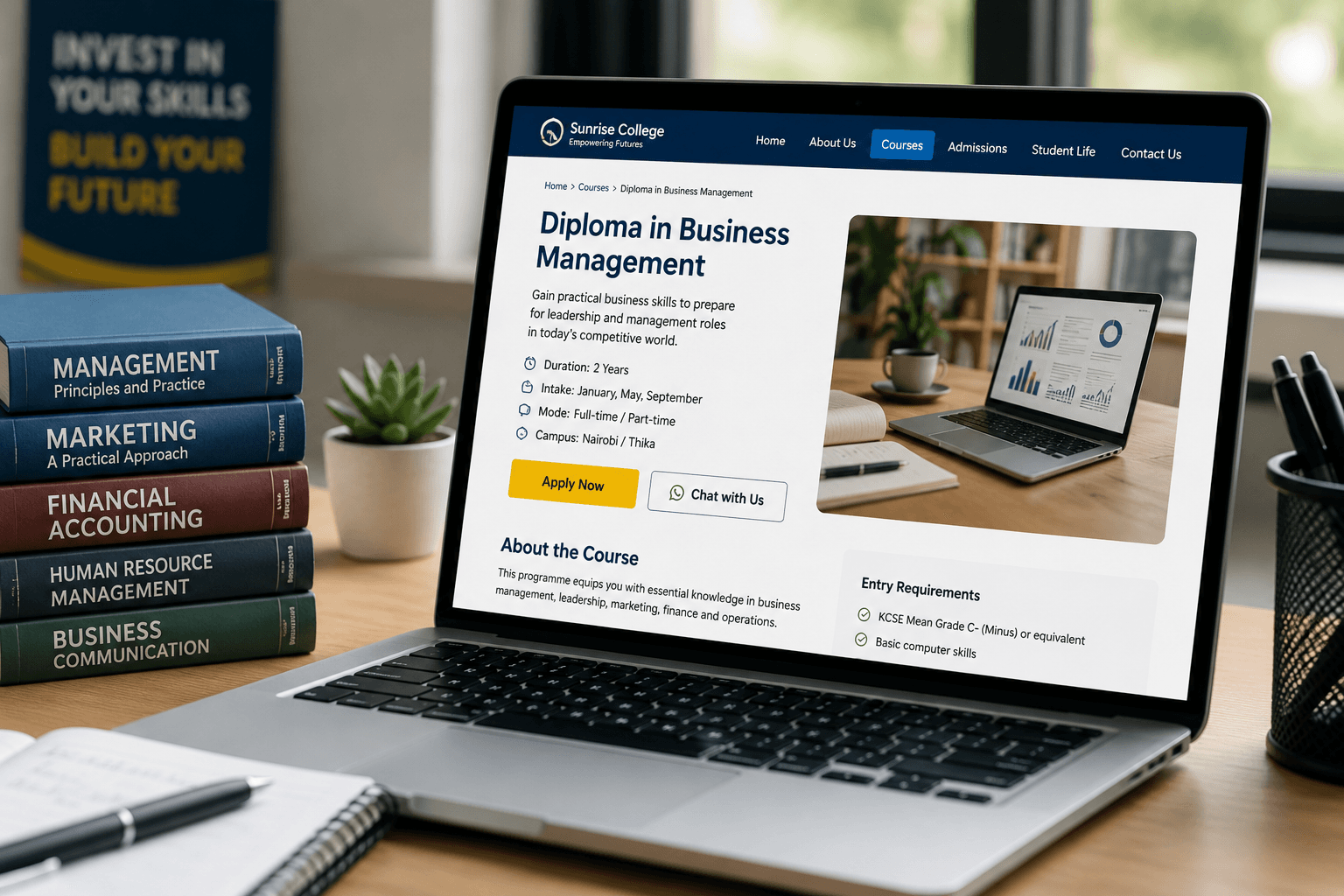
2. Create a Dedicated Page for Every Course or Programme
Many institutions place all their programmes on one general page. This makes it harder for Google to understand each course and harder for prospective students to find detailed information.
Each major course or programme should have its own page containing:
- Course name
- Entry requirements
- Duration
- Study mode
- Intake dates
- Fees or fee guidance
- Career opportunities
- Application process
- Frequently asked questions
For example, instead of listing “Diploma in Business Management” in a long course catalogue, create a dedicated page focused entirely on that programme.
This gives the page a stronger chance of appearing when someone searches for that specific course.
3. Optimise Your Website for Local Searches
Many parents and students search for institutions based on location. Google searches such as “schools near me” and “colleges in Nairobi CBD” are strongly influenced by local SEO.
Ensure that your institution’s name, phone number and physical location are consistent across your website and online profiles.
Your website should also mention the areas you serve. For example:
Our campus is located in Mlolongo, Machakos County, and is easily accessible from Nairobi, Athi River, Syokimau and Kitengela.
Institutions should also maintain an accurate Google Business Profile containing:
- Correct location
- Phone number
- Website address
- Opening hours
- Campus photographs
- Available programmes
- Student and parent reviews
A complete Google Business Profile can improve your institution’s visibility on Google Maps and local search results.
4. Publish Helpful Education Content
Blog posts allow your institution to answer common questions while attracting people searching for useful information.
Suitable topics may include:
- How to choose the right secondary school
- Questions to ask before joining a college
- Career opportunities after completing a diploma
- How parents can prepare children for boarding school
- Differences between certificate, diploma and degree programmes
- How to apply for the next intake
- Benefits of technical and vocational education
Helpful articles build trust before a parent or student contacts the institution.
Each article should guide readers towards a clear next step, such as viewing available courses, downloading a prospectus, booking a school visit or submitting an application.
5. Improve Website Speed and Mobile Usability
Most prospective students and parents in Kenya are likely to access your website using a mobile phone.
A slow or difficult-to-use website can cause visitors to leave before reading about your programmes.
Your website should:
- Load quickly on mobile data
- Use readable text
- Have clear navigation
- Display properly on different screen sizes
- Include visible enquiry and application buttons
- Use compressed images
- Avoid intrusive pop-ups
Application and enquiry forms should also be short and simple. Request only the information needed at the initial stage.
A potential student should be able to find a course and submit an enquiry without struggling through several complicated pages.
6. Use Clear Page Titles and Descriptions
Every website page should have a clear title that explains its content.
A weak page title may simply say:
Courses
A stronger SEO title would be:
Diploma and Certificate Courses in Nairobi | Institution Name
Similarly, the page description should encourage users to click by summarising what they will find.
For example:
Explore diploma, certificate and short courses offered at our Nairobi campus. View entry requirements, study options and upcoming intake dates.
Titles and descriptions help Google understand your pages and influence how your institution appears in search results.
7. Track Enquiries and Website Performance
SEO should be measured using real results.
Institutions should monitor:
- Number of website visitors
- Google search rankings
- Most visited course pages
- Enquiry form submissions
- Online applications
- Phone and WhatsApp enquiries
- Prospectus downloads
- School-visit bookings
This information helps management understand which courses attract the most interest and which pages require improvement.
For example, a college may discover that many people visit its accounting course page but few submit enquiries. The institution can then review the page, add clearer entry requirements, improve the call-to-action or simplify the enquiry form.
SEO Is a Long-Term Student Recruitment Strategy
SEO does not usually produce results overnight. However, a well-structured website can continue attracting enquiries long after a page or article is published.
For Kenyan schools, colleges and training institutions, SEO is not simply about ranking higher on Google. It is about helping the right parents and students discover the institution, understand its programmes and take the next step towards enrolment.
ENROLLus Education Marketing Agency helps education institutions improve their online visibility through professional websites, search engine optimisation, Google Business Profile management, content development and digital advertising.
A strong digital presence can turn online searches into enquiries, campus visits and applications.
Book a free 30-minute discovery call to identify the changes that could help your institution attract more qualified enquiries and increase student enrollment.